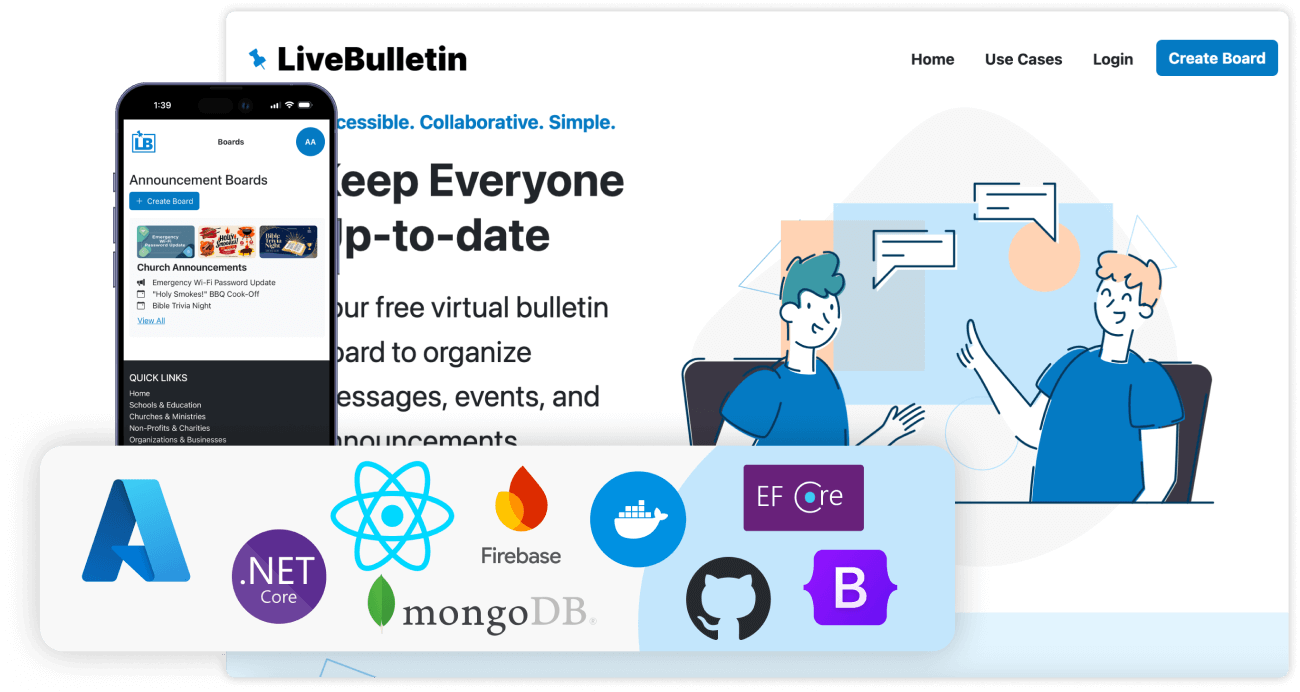
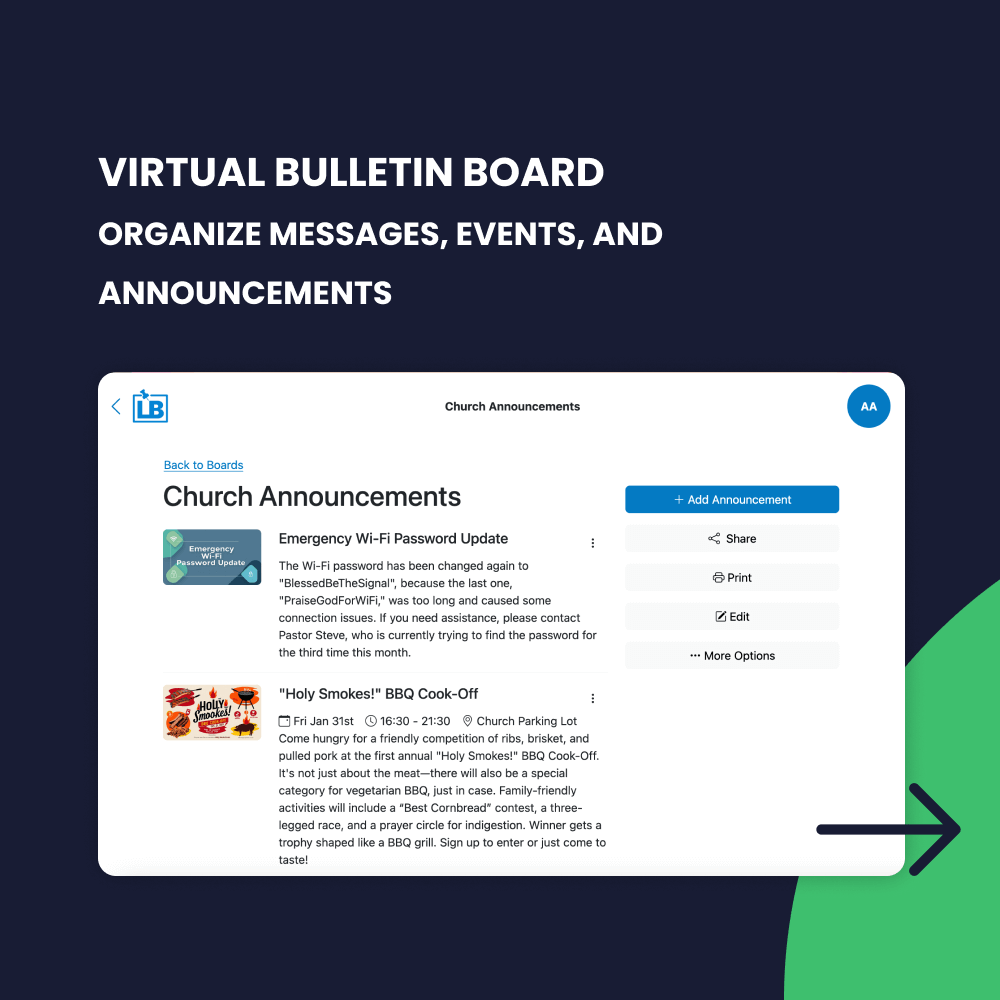
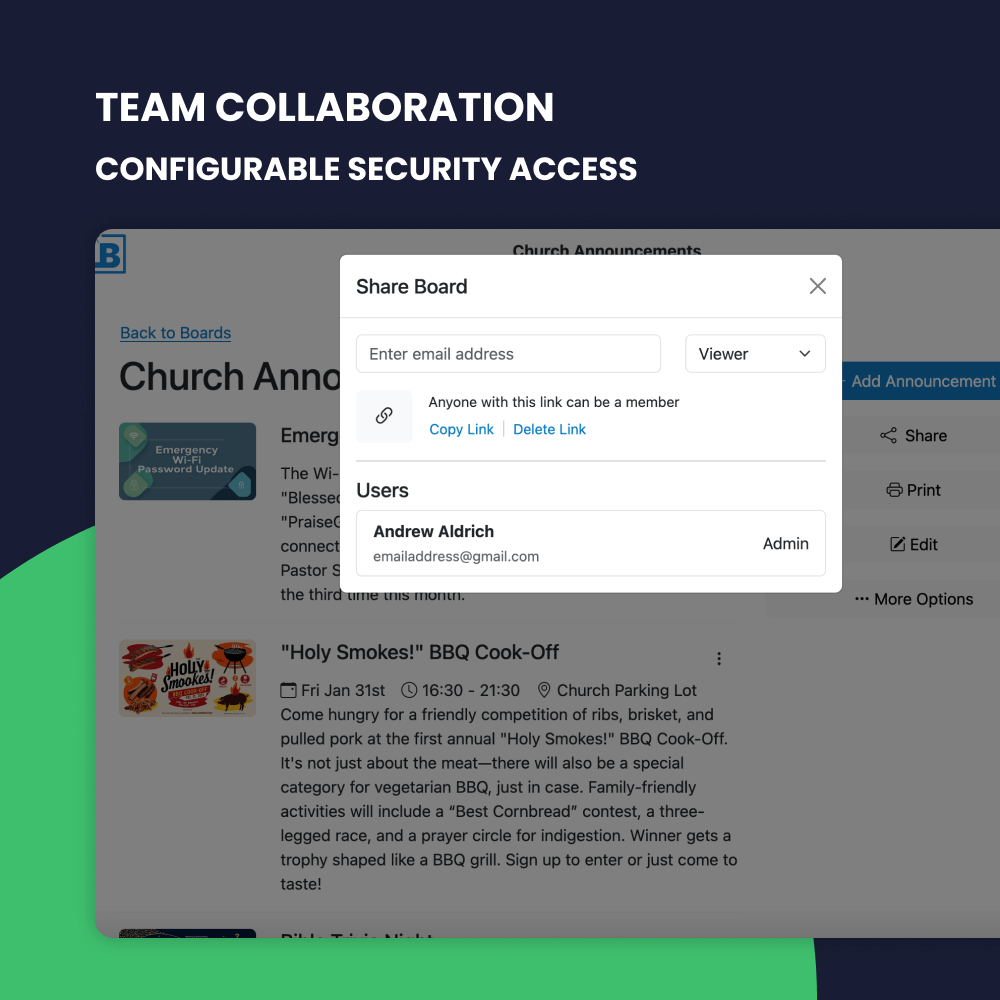
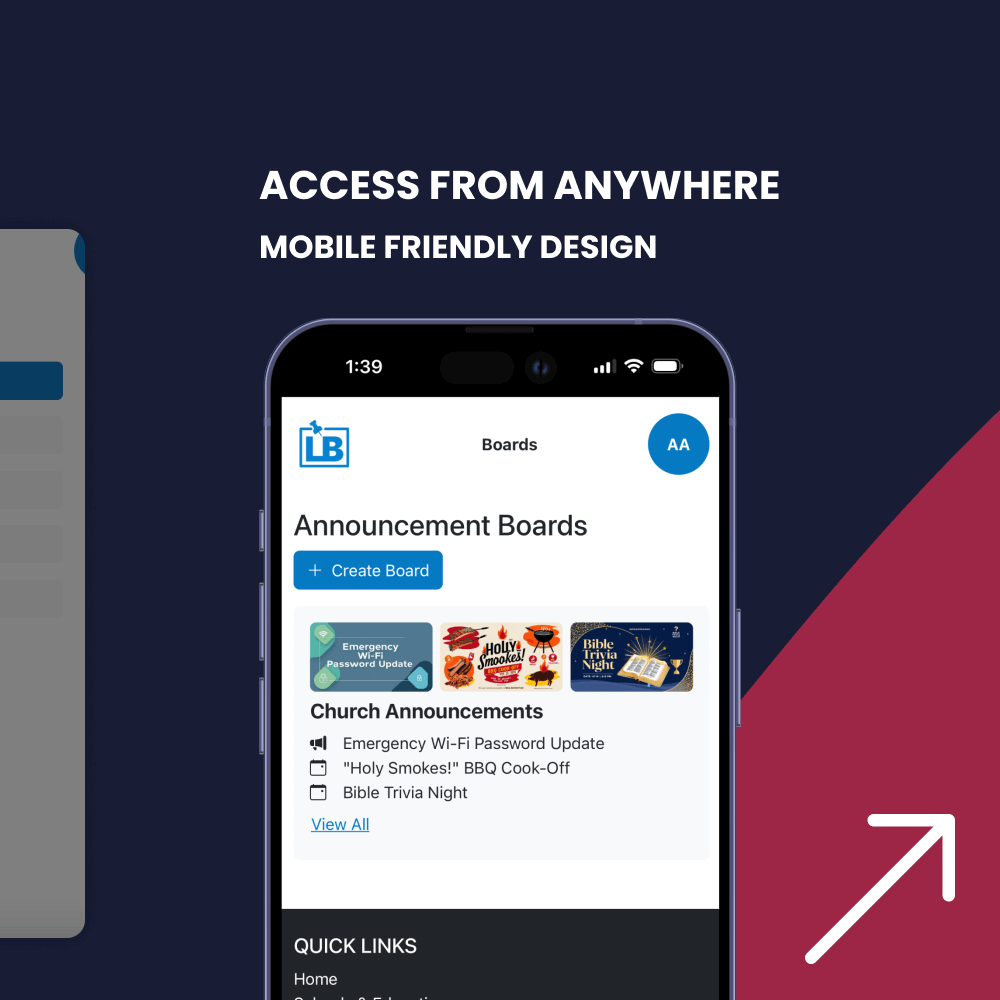
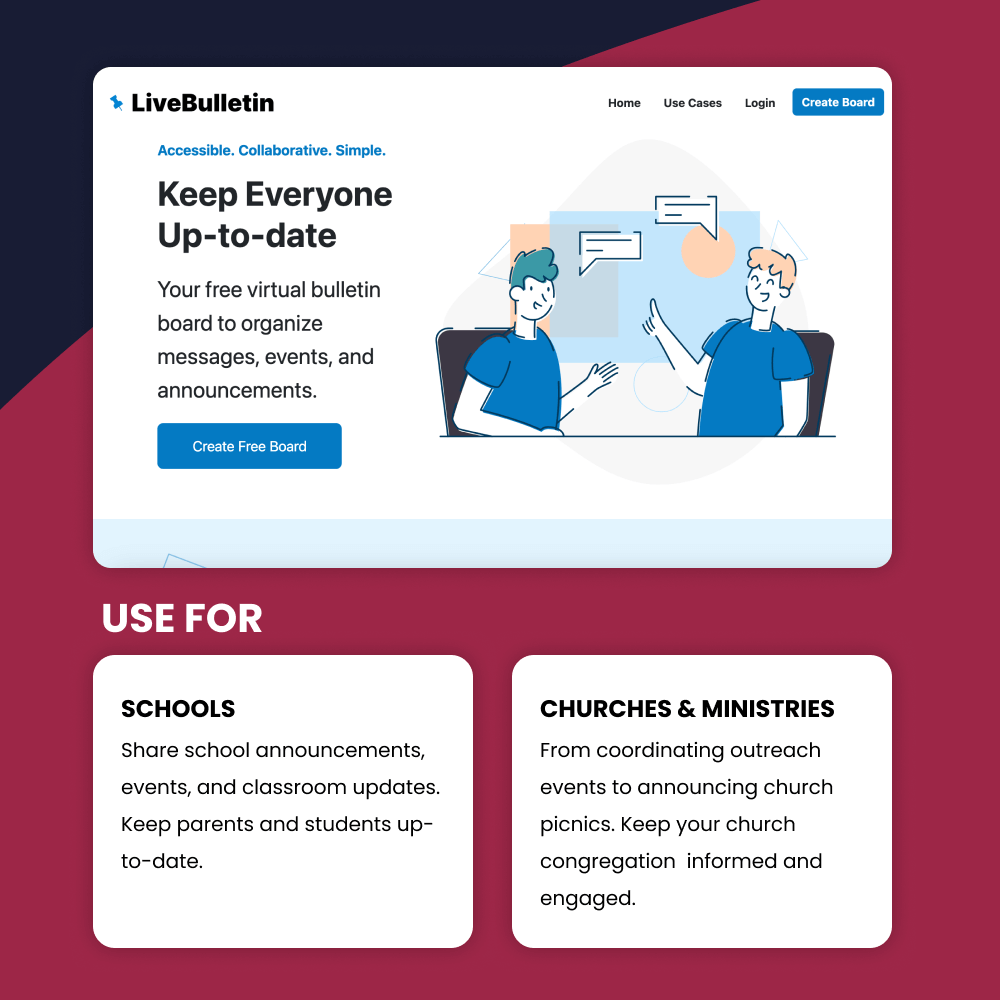
Most everyone has seen a bulletin board of some fashion. If you attend a church they might have a list of events and announcements posted. A school might have a board to inform people about school plays and other programs. These boards usually get overlooked or go unnoticed. I set out to create a simple virtual solution to help everyone get connected and stay informed.
I utilized .NET Core, C#, EF Core, and mongo db. Using EF Core I was able to easily connect to MongoDB to store everything needed for the app. On the frontend, I used React and Bootstrap css.
I wanted to explore cloud development and how I could publish this to the world. Through Docker Containers, I published the .NET Core app to Azure using web containers. Using web containers allows me to horizontally scale the app if it ever takes off. I decided to use MongoDB for the database as it offered a simple way to host it via MongoDB Atlas. I deployed the Azure container and connected it to the cloud DB. I then used Firebase to host the frontend. Google Firebase makes it easy to publish single-page applications and redirect all the traffic to index.html.
After setting up the back-end and front-end I went a step further and created a CI/CD pipeline using GitHub actions. With a simple commit to the main branch, I’m able to update and deploy the latest version of the app.
To deepen my understanding of AI, I developed a project to generate web pages based on a prompt. While generative AI could be used to generate HTML, I wanted to take a slightly different approach. Instead I fed into the AI model sections that represented HTML code. Each section defined what it was and what inputs were needed. I then allowed the model to choose the best sections and generate inputs for each section.
For this proof of concept AI project it was written in JavaScript. I utilized the ChatGPT 4o mini model from OpenAI as the AI model.
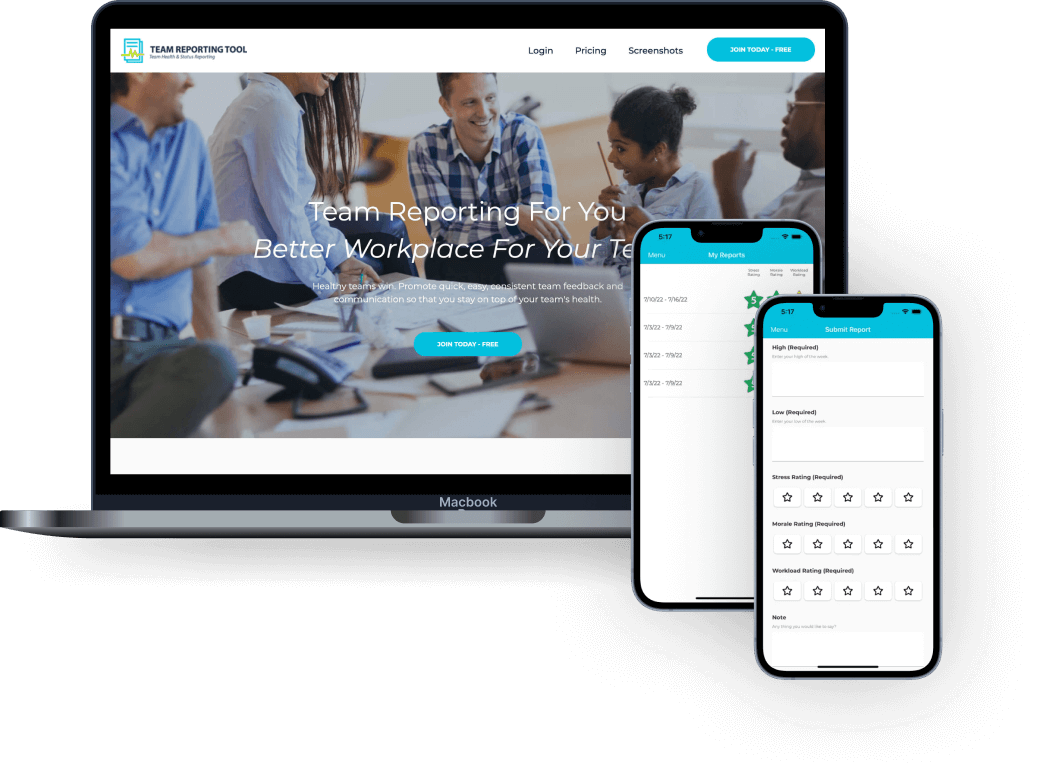
I developed this tool to promote healthy teams in the workplace. I
developed both a fully functional website and iOS and Android app.
(Another developer helped create the marketing and styling for the
site) Through building this application I learned a lot. It helped
me grow in full stack development.
The tool allows a business to invite team members. Team members
can then be assigned a leader. Every week team members fill out a
report. It asks simple question, such as their high and low of the
week and allows them to rate their stress, moral, and workload.
Also, I allowed for users to customize the report to add their own
questions and ratings.
For the backend layer, Entity Framework was utilized to write and access the SQL database. The data was then passed through several layers of business logic, view models, to the APIs. Data was then consumed on the frontend. Angular was used in the frontend with Bootstrap for the styling.
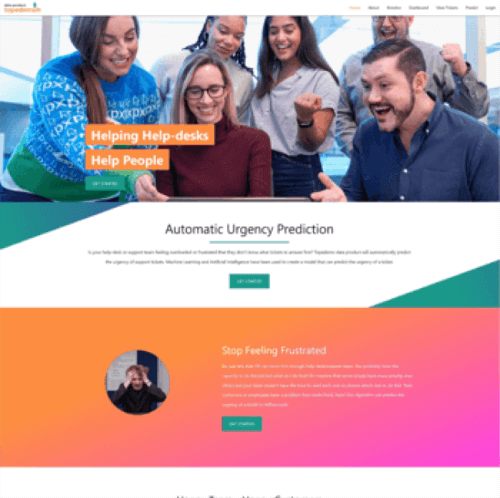
For my WGU capstone project I wrote a website that would use machine learning and AI to predict the urgency level of support tickets. The goal was that given a set of data that contains support tickets that have been labeled as urgent/not urgent on a scale of 0-3, the computer would be able to predict the urgency of a new support ticket. The project resulted in an accuracy result of 85.82%
I utilized Python for analyzing and build a model for the AI algorithm. Then I used the model and built the website using Flask. This made it easy to integrate the model and the site.
In my spare time, I worked on a personal project that combined my passion for music and software development. I aimed to create a website to manage chord charts and resources for songs, and to establish a community for sharing these resources with the world. The site included features such as sending friend requests, creating groups for sharing ideas, adding songs, creating playlists, and other tools useful for church musicians. In one version, I even added a real-time instant messenger for users to communicate. In addition to the site, I created a help section with documentation. The search had a simplistic search correction to offer "did you mean" functionality. I rewrote the project 2-3 times to improve the code, and initially started in Angular.JS before rewriting the frontend in Angular. I still hope to publish this site, as I believe it could greatly improve the workflow for church music teams.
I utilized .Net with Entity Framework for the backend. For the frontend, I used Angular. The realtime chat was written using SignalR.
In my spare time, I developed an infinite runner game called "Penguin Jump". This engaging game features a variety of power-ups and sound effects to enhance the player experience. Additionally, the app includes a store where players can use the coins they collect to purchase new skins for the penguin. One of my favorites is the transparent skin, which is just the outline of the penguin. A fun fact about this project is that the artwork for the penguin character was drawn by my sister, adding a personal and creative touch to the game. I took her artwork drawn in marker and digitized it. The development process allowed me to hone my skills in game design and programming.
I utilized Unity's game engine and C# for the game logic.
I built a tool at work to help our team — especially the developers — get the gist of helpdesk tickets at a glance and act accordingly. By pulling out critical details from each ticket, it saves our team the time of digging for context and key info. Also, since it's all about AI - Nearly all of the code was generated via Copilot, but I approached the project as if I were writing it myself—debugging, testing, and refining each piece individually before assembling everything into a working solution.
Node.js, OpenAI API, GitHub Copilot, VSCode, and ClickUp's REST APIs.
The tool looks for tasks in ClickUp that have a helpdesk ticket link but do not yet have a summary comment. Because our helpdesk system is outdated and lacks an API, the solution fakes a login via POST requests and manages cookies to retrieve ticket detail pages. Once it has the ticket data, it uses OpenAI to generate a concise summary and adds that as a comment in ClickUp, extracting the most actionable and relevant details of each ticket.
Copilot wrote about 99% of the code—sometimes even generating custom scripts to debug unique problems with our ClickUp data structure. I tested and debugged each part individually. The tool has been running for some time now, and I regularly reference these summaries to get caught up on ticket backgrounds rather than having to open and read the entire ticket.
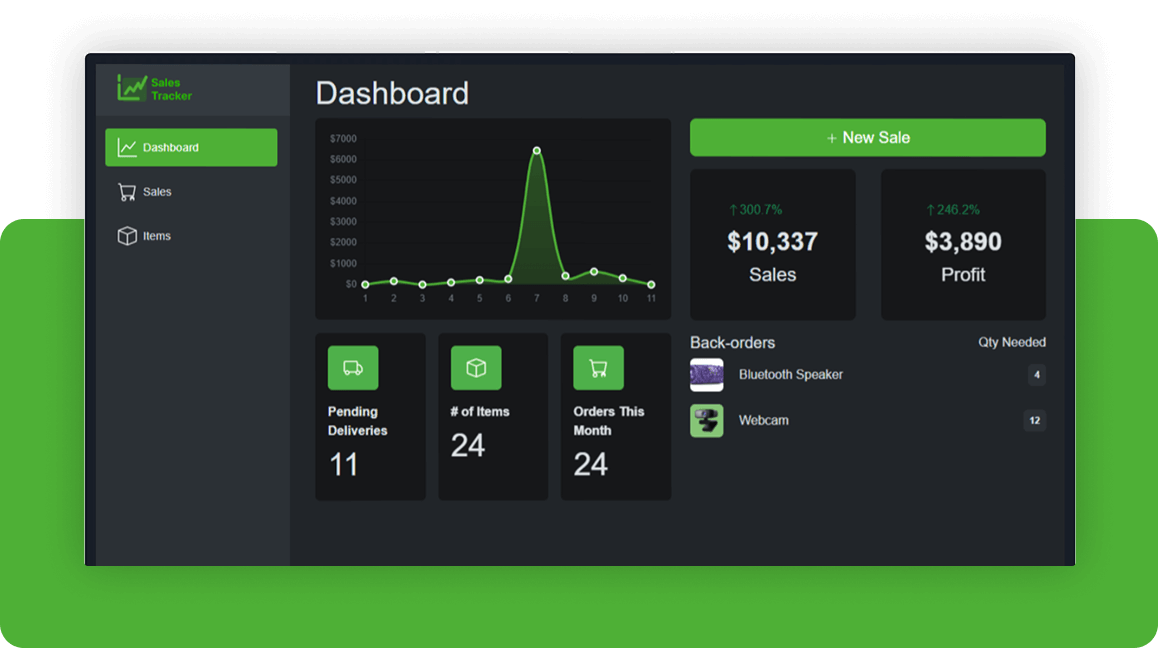
I developed a demo Sales Tracker and Inventory Management System to explore Blazor Hybrid and better understand how to share UI and business logic across native and web platforms. The application follows an offline-first approach and runs on desktop, mobile, and in the browser from a largely shared codebase. It includes a dashboard with monthly sales metrics, profit calculations, pending deliveries, and backorder detection. Users can create and manage sales with real-time inventory validation, automatic stock allocation, and item management with image uploads. The focus of the project was clean architecture, separation of concerns, and building a flexible data layer that could swap between storage implementations depending on platform.
The demo was built with .NET using .NET MAUI and Blazor Hybrid for native apps, and Blazor WebAssembly for the browser version. Native platforms use SQLite with Entity Framework Core, while the web version stores data locally using IndexedDB.